
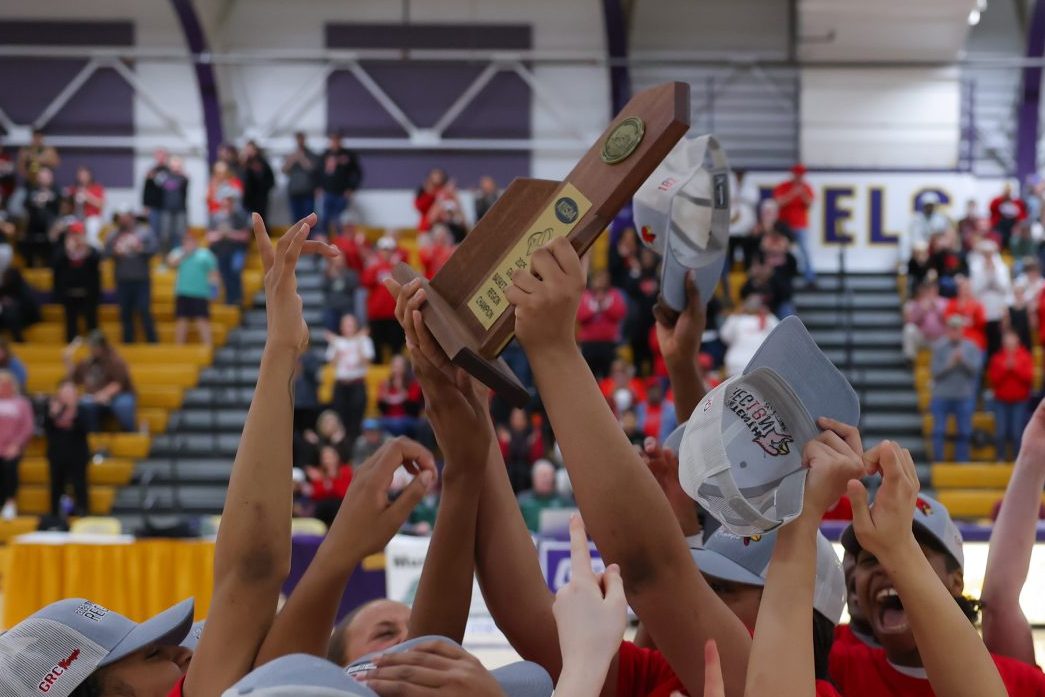

The 10th Region athletic directors voted to hold the first round of the 2026 10th Region Girls Basketball Tournament at the site of each district winner. Traditionally, the first round has always been played at a neutral site as part of the entire seven-game tournament. This will be the first time in the tournament’s 52-year history that the games will not all be played at one site.
Revenue increases can be misleading
Under the traditional format, fans could pay one ticket price and watch two games in the same session. With four separate first-round games at four locations, fans are paying to watch one game at one site. Even if the single-night ticket is cheaper, the price per game is higher.
Last year, fans paid $10 to watch two games on each of the two quarterfinal nights and the semifinals. That effectively made the cost $5 per game. This year, the cost for the first round is $8 per game. As a result, the tournament can show higher gross revenue without more people attending overall; fans are simply paying more per game.
Attendance may not actually increase
In the first round, let’s look at Bishop Brossart playing at George Rogers Clark. With the game being played at GRC, they will almost certainly bring more fans than if the game were played at Harrison County. However, that creates a trade-off, as fewer Bishop Brossart fans may make the 90-plus-minute drive to Winchester.
Thinking hypothetically, Clark might bring 200 fans and Brossart 100 fans to a neutral site. With the game at Clark, that could simply mean Clark brings 250 fans and Brossart only 50, leaving the total attendance the same. That would also mean those same 300 fans are paying $8 instead of $10, resulting in $600 less in ticket revenue.
Costs can increase because events are spread out
A single-site session concentrates tournament staff in one building. A four-site setup requires multiple sets of workers and expenses at the same time. That can include ticketing staff, security, custodians, and game management. Even if attendance rises, higher or duplicated operating costs can reduce the net profit. Net revenue is what matters if the goal is to increase the payout that gets shared.
Travel can become less consistent and less fair
A central regional site, such as Harrison County or Mason County, spreads travel more evenly. With hosted first-round games, travel depends on matchups. Some teams and fan bases will have short drives to a home environment, while others will have longer travel and play a true road game.
District runners-up playing on the road creates an advantage for the hosting district champions. While it does reward teams for winning their district, those teams are already rewarded by drawing a district runner-up.
In the case of district runners-up Bishop Brossart and Montgomery County, both would travel more than an hour and a half for a true road game. Looking at Montgomery County, they have been the district runner-up for the past six years, even though during that span they have been a top-three team in the region. It is basically setting them up to unfairly play on the road in the first round every year.
For fans, the format also means separate trips for single games instead of one trip where multiple games can be seen.
Mileage reimbursement costs remain mostly the same
Harrison County is the most equidistant point in the 10th Region and is easily reached by every team in the region. The first-round games pair the 37th and 40th Districts together, which are on opposite ends of the region.
Teams are only reimbursed for the travel of the basketball team bus. They are not reimbursed for the travel of their band or cheerleaders. Teams are typically given $1.50 per mile traveled.
Here is the current travel:
Montgomery County to Campbell County (80.7 miles, 102 minutes)
Bishop Brossart to George Rogers Clark (78.5 miles, 96 minutes)
Bracken County to Nicholas County (35.9 miles, 52 minutes)
Pendleton County to Mason County (40.6 miles, 55 minutes)
Total mileage: 235.7 ($353.55)
Travel to Harrison County:
Montgomery County (38.4 miles, 55 minutes)
Campbell County (41.6 miles, 50 minutes)
Bishop Brossart (44.3 miles, 54 minutes)
George Rogers Clark (33.5 miles, 49 minutes)
Bracken County (29.2 miles, 45 minutes)
Nicholas County (17.2 miles, 29 minutes)
Pendleton County (24 miles, 31 minutes)
Mason County (44.4 miles, 56 minutes)
Total mileage: 272.6 ($408.90)
This means that only 36.9 miles are saved in travel, equating to $55.35 saved total, or about $6.91 per team. While this changes from year to year based on the host, additional mileage could be saved if the host school, in this case Harrison County, qualified for the regional tournament.
Fans lose the ability to watch multiple games
With a single site, fans can watch a full session and see more than one team in a night. With four games happening simultaneously at different gyms, fans must choose one game. That reduces the ability for fans to watch all the games and lowers the overall “regional tournament” feel.
This year, the top four teams are playing in the first round: Campbell County vs. Montgomery County and George Rogers Clark vs. Bishop Brossart. Mason County vs. Pendleton County, whose teams are ranked fifth and seventh in the region, respectively, is also a strong matchup. Unfortunately, fans will only be able to choose one of these first-round games to attend.
Number of officials needed increases
Having four games on one night at the same time requires the assigned officiating association, which this year is the 9th Region, to send its top 15 available officials: three on-court officials and one alternate per game. If there were only two games per night, that number would be reduced to eight. While the officials working the region are the top-rated officials in their association, it is still better to have as many of the very best available as possible.
Media coverage becomes harder
When games are played at the same time in different locations, it becomes harder for media outlets to cover all of them. Radio stations in Cynthiana, Maysville, Mt. Sterling, and Winchester broadcast all the games every year. There are also several print newspapers, websites and podcasts, as well as freelance photographers, who will not be able to cover the whole tournament.
The simultaneous games can reduce overall media coverage, especially for girls’ basketball teams that already receive less attention.
What about the 6th and 7th Regions?
This is the same format the 6th and 7th Regions have used for several years. However, they do not have fan support like the 10th Region, as shown by their first-round attendance. Using the latest financial reports available, in 2023 the 6th Region averaged 118 fans for each first-round game, and in 2022 the 7th Region averaged 163 fans in the first round. One game in the 7th Region had an embarrassing crowd of just 65 fans, giving each team a payout of $2.50.
They also use this format out of convenience, as Valley High School, the largest high school gymnasium in Louisville, is used for the semifinals and finals of the girls’ and boys’ 6th and 7th Region tournaments.
Alternative solutions
If the main goal is to increase revenue, there are other ways this could be accomplished.
One way would be to decrease the allowance to the host school, which was $4,500 last year when all the games were played at one site. The host school already gets reimbursed for the cost of security, gate workers, athletic trainers, and scorer’s table workers. It also keeps all of the profit from concessions. The only remaining expenses are utilities, such as water and electricity, and custodial costs. Tournament management gets $600 as well.
Tournament directors could also seek a sponsor to cover some of the tournament cost, as St. Elizabeth Healthcare does for the 9th Region Tournaments.
Another idea would be to hold the first round of the girls’ regional tournament on Saturday or Sunday. Playing games on the weekend could increase attendance.
They could then follow a format similar to the 9th Region:
Saturday or Sunday: Quarterfinals at 1:00, 2:30, 6:00, and 7:30
Monday: Semifinals
Tuesday: Championship
Even if district champions do host the first round, playing two games on Monday and two on Tuesday could increase revenue and allow media and fans to attend more than one game.
Matchups and travel remain the most important factors in financial profit
Who is playing and where they are playing are still the most important factors for fans when deciding whether to attend a game. Some fan bases bring more fans than others, and some are more willing to travel. In some years, the tournament may have multiple good games with limited travel, while in other years the games may not be competitive and may involve significant travel.
To be fair, while George Rogers Clark does have a large number of traveling fans, few people really want to watch them beat every team in the tournament by 30 points, which is exactly what has happened the last three years and is a possibility again this year.
While the 10th Region Athletic Directors who supported this new format had good intentions in trying new, innovative ways to increase attendance, interest, and revenue, it may do more harm than good.
You can view last year’s regional tournament financial report here.


You must be logged in to post a comment Login